Institutional Insights: JPMorgan Delta One Flows & Positioning 22/7/26

Delta-One Flows & Positioning
Top Takeaways
Semis remain the dominant dip-buying theme. Investors aggressively bought semiconductor ETFs despite broader market weakness, with large inflows into SOXX, SOXL, and DRAM.
Korea saw record ETF inflows. After roughly four months of softer demand, Korea attracted its largest weekly net inflow on record at $3.3bn, largely through EWY.
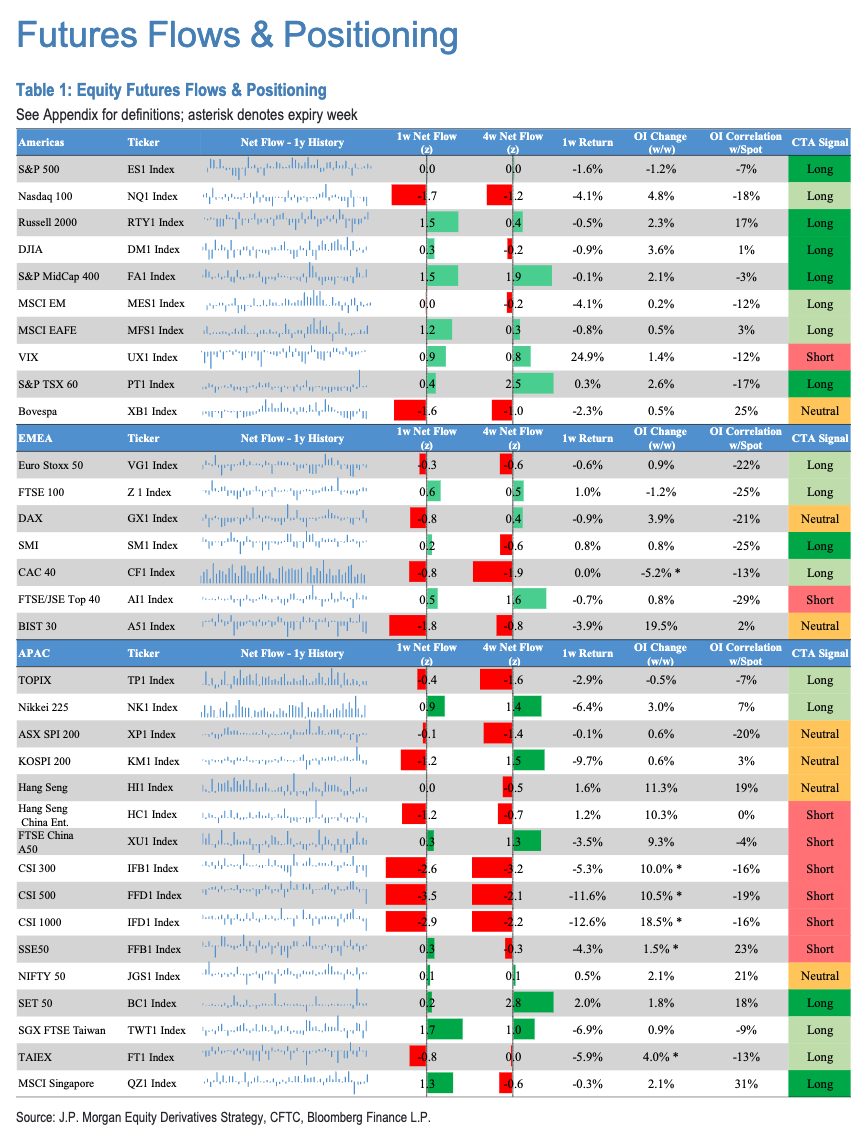
Futures and ETFs sent very different signals. Equity futures were heavily net sold as markets weakened, led by NDX, while equity ETFs still saw moderately above-average inflows. In other words: futures de-risking, ETF dip-buying.
Rates futures were bought, but bond ETF demand was weak. Bond futures saw strong net buying, while fixed-income ETF inflows were subdued.
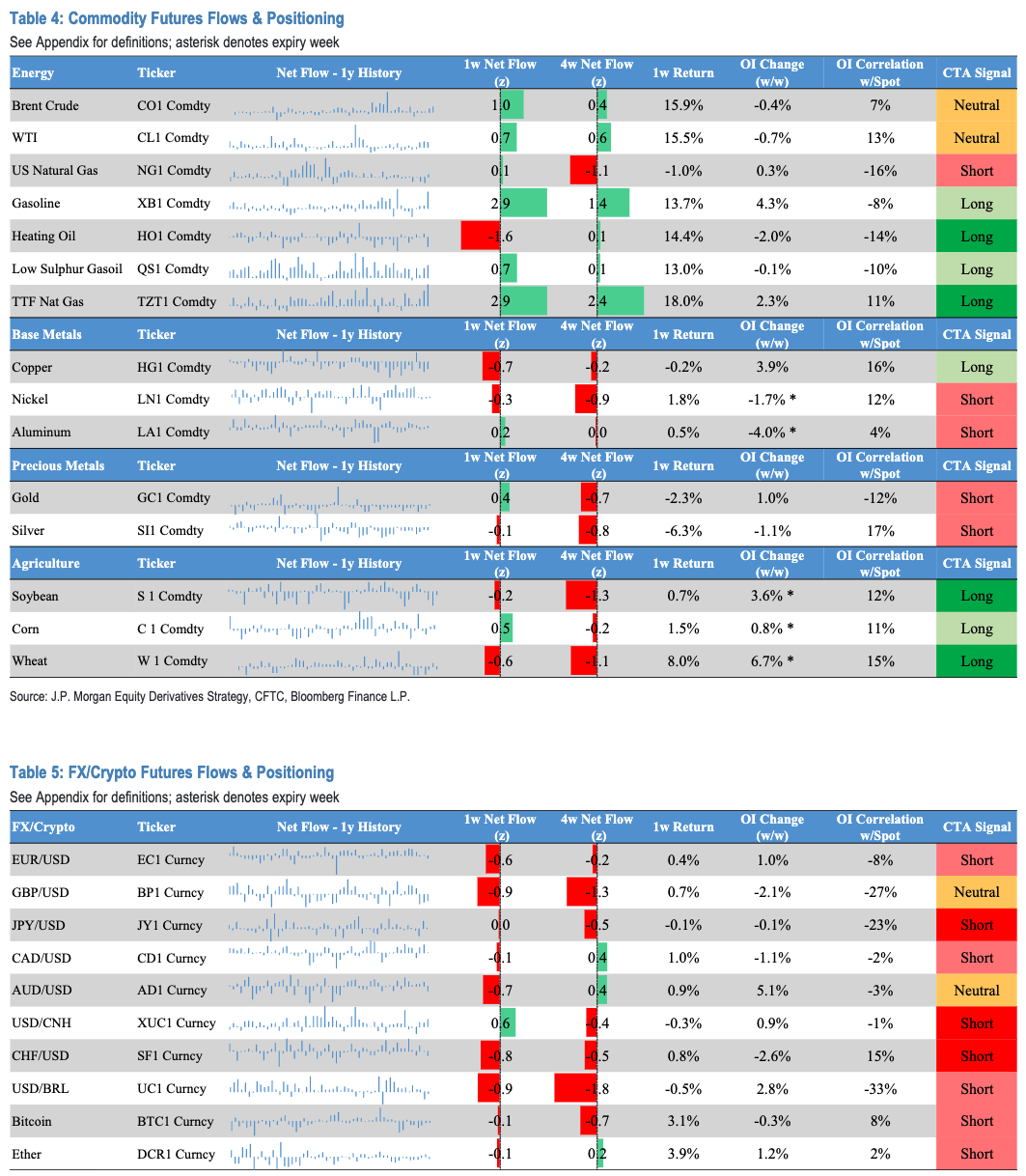
Energy was bid on Middle East escalation. Gasoline futures saw very strong buying, around 3z, while CTAs likely added energy exposure as prices rose.
CTAs likely trimmed equities and bought energy. CTA positioning likely remains broadly long global equities ex-China, but last week’s weakness and higher volatility probably forced some reduction.
Weekly Flow Highlights
US ETF Flows: Equities Still Attracting Money
Over the last week, US-listed ETF flows showed:
Asset Class | Flow | Z-score | Takeaway |
|---|---|---|---|
Equities | +$32.3bn | +0.4z | Above-average inflows |
Fixed Income | +$8.1bn | -0.8z | Weak inflows |
Commodities | Roughly flat | — | Little net demand |
Currency / Multi-asset | +$0.5bn | 0z | Near average |
The key message: even with risk under pressure, equity ETF demand remained resilient, especially in semis and tech.
Equity ETFs: Tech and Semis Lead Again
Technology was the clear sector winner.
Tech ETF inflows: +$6.6bn, +3.1z
Semis were the main driver
SOXX: +$4.2bn
SOXL: +$1.9bn
DRAM: +$1.8bn inflow in thematic ETFs
This points to investors using the market weakness to reload semiconductor exposure.
Other sector flows
Sector | Flow Signal |
|---|---|
Financials | Strong inflows, +$1.4bn, +1.5z, helped by bank earnings |
Industrials | Notable outflows, -1.3z |
Materials | Notable outflows, -1.3z |
Real Estate | Outflows, -0.9z |
Regional ETF Flows: Korea Stands Out
Regionally:
US: +$21.6bn, +0.3z
Modestly above-average inflows.
International DM: +$6.0bn, -0.2z
Slightly below average.
Korea: +$3.3bn, +4.9z
Record weekly inflow.
Largely driven by EWY.
The Korea inflow is one of the most important signals in the report, especially given the broader semiconductor and memory theme.
Style and Thematic Flows
Equity styles
Low Vol: solid inflows, +1z
Growth: outflows, -0.7z
This is a notable split: investors are still buying tech/semis, but broader growth style demand was weaker.
Option-based ETFs
Option strategies saw strong inflows:
Call-writing ETFs: +$1.6bn, +1.3z
Defined-outcome ETFs: +$0.9bn, +2.1z
However, more than half of defined-outcome inflows went into HELO, potentially linked to a custom in-kind basket rebalance.
Thematics
Headline thematic flows looked weak because of the redemption leg of ARK CIBs flagged previously.
Excluding that distortion, thematic flows were closer to average, with the standout being:
DRAM: +$1.8bn
Levered ETFs: Dip-Buying in Semis
Levered ETF flows confirm the semiconductor dip-buying theme.
Inflows included:
SOXL: around +$1.9bn
TQQQ / KORU combined: around +$0.7bn
There were also outflows from inverse funds:
SQQQ / SOXS combined: around -$0.4bn
That points to investors reducing bearish expressions while adding levered upside exposure.
However, levered single-stock ETFs saw outflows:
Levered single-stock products: -$0.8bn, -1.3z
Led by redemptions in products linked to:
NVDA
TSLA
MU
SNDK
So the demand was more for broad semi/beta exposure than single-name levered products.
Futures Flows
Big Picture: De-risking in Equity Futures
Global futures flows showed a different picture from ETFs.
Equity futures saw heavy net selling, particularly in NDX, consistent with de-risking during market weakness.
Large net buying, above +1.5z
Asset / Contract | Signal |
|---|---|
RTY | Large buying |
MID | Large buying |
FTSE Taiwan | Large buying |
Germany 10y / 30y | Large buying |
UK 10y | Large buying |
Gasoline | Large buying |
TTF Natgas | Large buying |
Large net selling, below -1.5z
Asset / Contract | Signal |
|---|---|
NDX | Large selling |
Bovespa | Large selling |
BIST 30 | Large selling |
CSI 300 / 500 / 1000 | Large selling |
SONIA | Large selling |
Heating Oil | Large selling |
The futures message is more cautious than the ETF message: institutional/fast-money accounts appear to have reduced risk, especially in index futures.
CTA Positioning
CTAs Likely Trimmed Equities, Bought Energy
CTAs likely reduced equity longs week-on-week as:
Markets dipped
Volatility rose
Iran escalation headlines lifted energy prices
However, they likely remain broadly long global equities, excluding China.
Estimated CTA positioning
Asset Class | CTA Stance |
|---|---|
Global equities ex-China | Still broadly long, but trimmed |
Energy | Bought futures as prices rose |
Global rates | Short |
Precious metals | Short |
Global FX vs USD | Short |
Agriculture | Long |
The key shift was likely less equity length and more energy exposure.
CFTC Positioning
Asset Managers and Leveraged Funds Reduced Equity Futures
CFTC data showed selling across key equity futures.
Asset Managers
Asset Managers sold around 1z of:
SPX
NDX
MID
Leveraged Funds
Leveraged Funds sold around 1z of:
RTY
NDX
EM
Managed Money in Commodities
Managed Money:
Added to Brent longs: +1.9z
Increased US Natgas shorts: -1.9z
Covered Wheat shorts: +1.6z
The commodity picture is consistent with the broader theme: energy risk premium is being rebuilt on Middle East escalation.
The report shows a clear split:
ETFs: investors are still buying the dip, especially in semis, tech and Korea.
Futures: positioning looks more defensive, with equity futures de-risking and rates/energy futures being bought.
CTAs: likely reduced equities and added energy.
Macro overlay: Middle East risk is lifting energy exposure, while equity weakness is not yet stopping ETF dip-buying.
The cleanest theme remains: semiconductor dip-buying is alive and well, with Korea now joining as a major flow beneficiary.
Disclaimer: The material provided is for information purposes only and should not be considered as investment advice. The views, information, or opinions expressed in the text belong solely to the author, and not to the author’s employer, organization, committee or other group or individual or company.
Past performance is not indicative of future results.
High Risk Warning: CFDs are complex instruments and come with a high risk of losing money rapidly due to leverage. 68% and 74% of retail investor accounts lose money when trading CFDs with Tickmill UK Ltd and Tickmill Europe Ltd respectively. You should consider whether you understand how CFDs work and whether you can afford to take the high risk of losing your money.
Futures and Options: Trading futures and options on margin carries a high degree of risk and may result in losses exceeding your initial investment. These products are not suitable for all investors. Ensure you fully understand the risks and take appropriate care to manage your risk.
Patrick has been involved in the financial markets for well over a decade as a self-educated professional trader and money manager. Flitting between the roles of market commentator, analyst and mentor, Patrick has improved the technical skills and psychological stance of literally hundreds of traders – coaching them to become savvy market operators!