FTSE Finish Line: July 16 — FTSE Edges Higher as Services Rescue GDP, Breeden Validates “No Hawk, No Hike” View
FTSE Finish Line: July 16 — FTSE Edges Higher as Services Rescue GDP, Breeden Validates “No Hawk, No Hike” View
London recovered from an early decline on Thursday, with the FTSE 100 inching into positive territory as stronger services output helped the UK economy avoid stagnation in May. The gain was modest rather than emphatic, with investors still reluctant to extend risk meaningfully while the conflict in the Middle East continued to cloud the inflation, growth, and shipping-cost outlook. The session had a cautious feel from the start. Escalating tensions around Iran and the Strait of Hormuz kept investors alert to oil, freight, and insurance risks, while the market remained unwilling to price a clean improvement in the macro backdrop. Still, the FTSE managed to regain positive territory as domestic data came in slightly better than expected and Bank of England commentary helped reinforce the idea that policymakers are not eager to respond mechanically to an energy-driven inflation shock.
The UK economy expanded by 0.1% in May, according to the Office for National Statistics, beating expectations for a flat reading and offsetting April’s 0.1% decline. The detail was uneven but not disastrous. Services output rose 0.3%, reversing April’s 0.1% fall and providing the main support to growth. Industrial output fell 0.5% after a 0.2% rise in April, although manufacturing edged up 0.1%. Construction remained the weak point, shrinking 0.8% after a 0.1% decline in April. The data reinforced the current UK macro picture: the economy is still moving forward, but only narrowly and unevenly. Services are doing enough to keep activity positive, while construction and industrial production remain fragile. On a yearly basis, GDP rose 1.3% in May. In the three months to May, GDP grew 0.7%, slightly slower than the 0.8% expansion in the three months to April. The economy expanded 1.1% compared with the same period last year. Trade data offered a small additional support. The visible trade deficit narrowed to a four-month low of £18.66 billion in May from £24.58 billion in April, while the services trade surplus edged up to £17.6 billion from £17.5 billion. That helped the broader macro tone, but it did not change the bigger message that UK growth remains dependent on services and vulnerable to external shocks.
Bank of England Deputy Governor Sarah Breeden provided the day’s most important policy signal. Speaking to Bloomberg TV, she said her focus is on how the energy price shock is being absorbed in the economy. She added that the Bank is in a good place to monitor developments very carefully, and that absent the current shock she was confident inflation would have been at 2%. Breeden’s comments were significant because they supported the market’s emerging “active hold” interpretation of the MPC’s stance. She made clear that the Bank would act if inflation looked like becoming embedded, but she also said the UK has a softish economic outlook, making an energy price shock less likely to require policymakers to lean against inflationary pressures.That is the core of the current rates debate. A renewed oil shock is inflationary in the near term, but for the UK it is also a demand shock. Higher energy prices squeeze real incomes, lift costs for firms and consumers, weaken discretionary spending and can ultimately pull demand-led inflation lower. Breeden’s comments suggest the BoE is more focused on whether the shock becomes persistent through wages, margins and expectations than on the mechanical rise in headline inflation alone. This is why the “no hawk, no hike” framework remains intact. The Bank can maintain an active hold, using communication to keep inflation expectations contained, while avoiding an additional rate increase that could worsen an already soft growth outlook. If the MPC were to hike into a fragile economy and hold rates there, it would likely need to deliver deeper and faster dovish compensation later. Breeden’s remarks therefore leaned against the idea of an automatic policy response to higher energy prices.
Politics also moved further into focus. The Financial Times reported that incoming UK Prime Minister Andy Burnham is likely to appoint current Home Secretary Shabana Mahmood as Chancellor of the Exchequer. Markets have largely priced in Burnham’s path to Downing Street, so the Chancellor choice is now the more important question. Investors will want clarity on fiscal rules, infrastructure funding, tax enforcement, public spending priorities and the government’s approach to gilt-market credibility. A Mahmood appointment would land against a constrained fiscal backdrop. The OBR has warned that long-term UK debt dynamics could become unsustainable without policy action, while elevated gilt yields continue to limit room for manoeuvre. The HMRC tax gap, recently estimated at £59.2 billion, remains a potential revenue focus for the incoming government if it can increase compliance without raising headline tax rates. But markets will still expect a credible medium-term plan rather than relying on enforcement alone.
On the stock front, industrial and engineering names led the positive side of the ledger. Diploma rose 5.3%, Weir Group gained 3.7% and Spirax Group climbed 3.1%. IMI, Metlen Energy & Metals, Kingfisher, Smiths Group, Halma and Bunzl gained between 1% and 2.2%. The strength in this group suggested investors were willing to buy quality operational stories even while avoiding a broad risk-on move. The downside was more stock-specific but still meaningful. Ocado slumped 19% after confirming further delays to two fulfilment centres under development. The reaction reflected renewed concern over execution risk, revenue timing and partner confidence in the group’s technology model. In a market still sensitive to valuation and profitability questions, delays were punished heavily. St. James’s Place fell 5.5%, remaining under pressure after recent concerns around distribution and partner relationships. Experian lost about 3.1% despite maintaining its full-year outlook, suggesting investors were underwhelmed after previous strength in data and technology-linked names. BHP shed about 3% after reporting a 5% drop in fourth-quarter copper production, adding to recent pressure on miners following weaker-than-expected Chinese GDP growth. Other fallers included Centrica, down 2.5%, while Compass Group, Admiral, SSE, National Grid, Hiscox, Smith & Nephew, Convatec, Rio Tinto, RELX, Polar Capital Technology Trust, JD Sports, Games Workshop and Prudential lost between 1% and 1.7%. The spread of decliners across utilities, healthcare, consumer, insurers, data and miners showed that the index’s positive close was narrow rather than broad-based.
Finish Line: The FTSE 100 edged into positive territory after recovering from early weakness, supported by a slightly better-than-expected UK GDP print and firmer industrials. Services output kept the economy growing in May, but construction and industrial production remained weak. Sarah Breeden’s comments strengthened the case for a BoE “active hold,” with policymakers monitoring the energy shock rather than automatically leaning against it unless inflation becomes embedded. Politics is now shifting toward fiscal credibility, with reports that Shabana Mahmood may become Chancellor under Andy Burnham. The market finished higher, but the tone remained cautious: Middle East risk, fragile growth, narrow leadership and fiscal constraints continue to cap conviction.
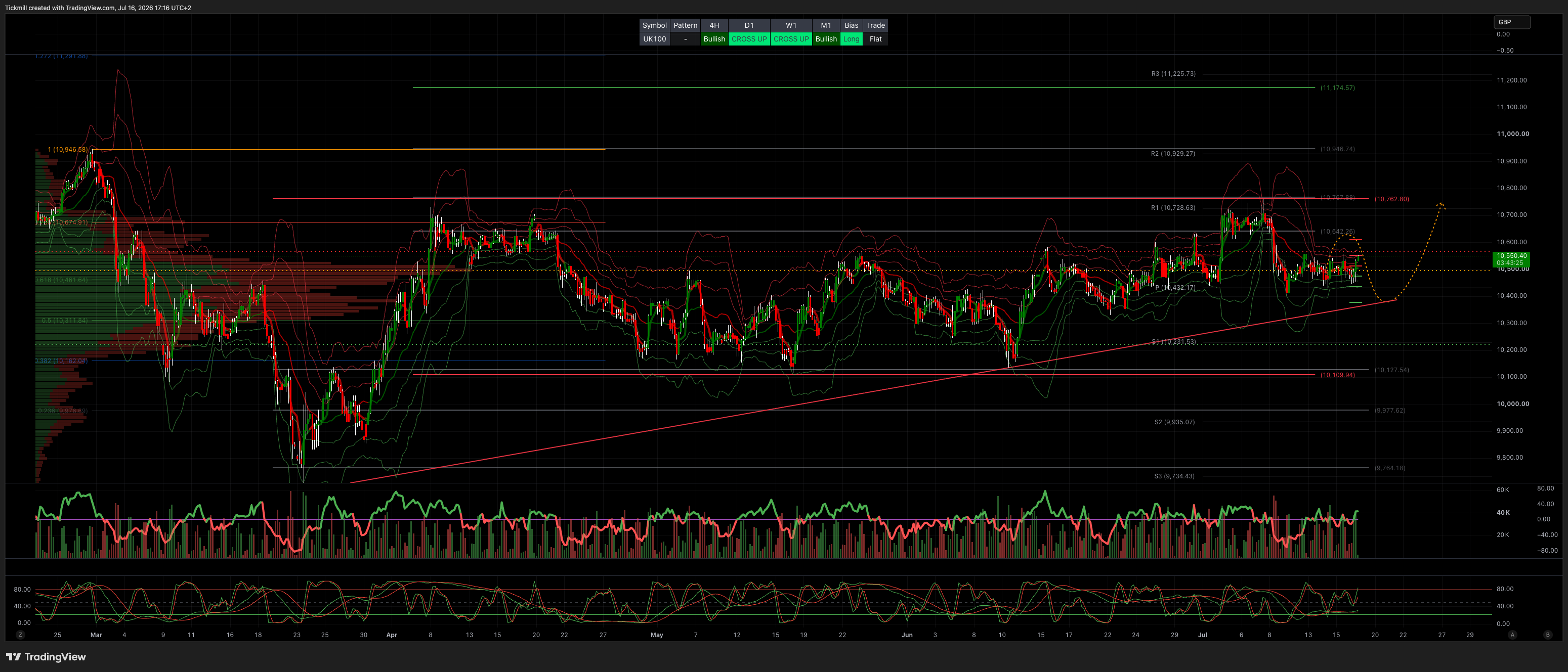
TECHNICAL & TRADE VIEW – FTSE100
Daily VWAP Bearish>Bullish
Weekly VWAP Bearish>Bullish
Above 10300 Target 11000
Below 10100 Target 9469
Disclaimer: The material provided is for information purposes only and should not be considered as investment advice. The views, information, or opinions expressed in the text belong solely to the author, and not to the author’s employer, organization, committee or other group or individual or company.
Past performance is not indicative of future results.
High Risk Warning: CFDs are complex instruments and come with a high risk of losing money rapidly due to leverage. 68% and 74% of retail investor accounts lose money when trading CFDs with Tickmill UK Ltd and Tickmill Europe Ltd respectively. You should consider whether you understand how CFDs work and whether you can afford to take the high risk of losing your money.
Futures and Options: Trading futures and options on margin carries a high degree of risk and may result in losses exceeding your initial investment. These products are not suitable for all investors. Ensure you fully understand the risks and take appropriate care to manage your risk.
Patrick has been involved in the financial markets for well over a decade as a self-educated professional trader and money manager. Flitting between the roles of market commentator, analyst and mentor, Patrick has improved the technical skills and psychological stance of literally hundreds of traders – coaching them to become savvy market operators!