Institutional Insights: Goldman Sachs Q2 Earnings Playbook 2026

Goldman Sachs Q2 Earnings Playbook — High Bar, but Earnings Still Driving the Market
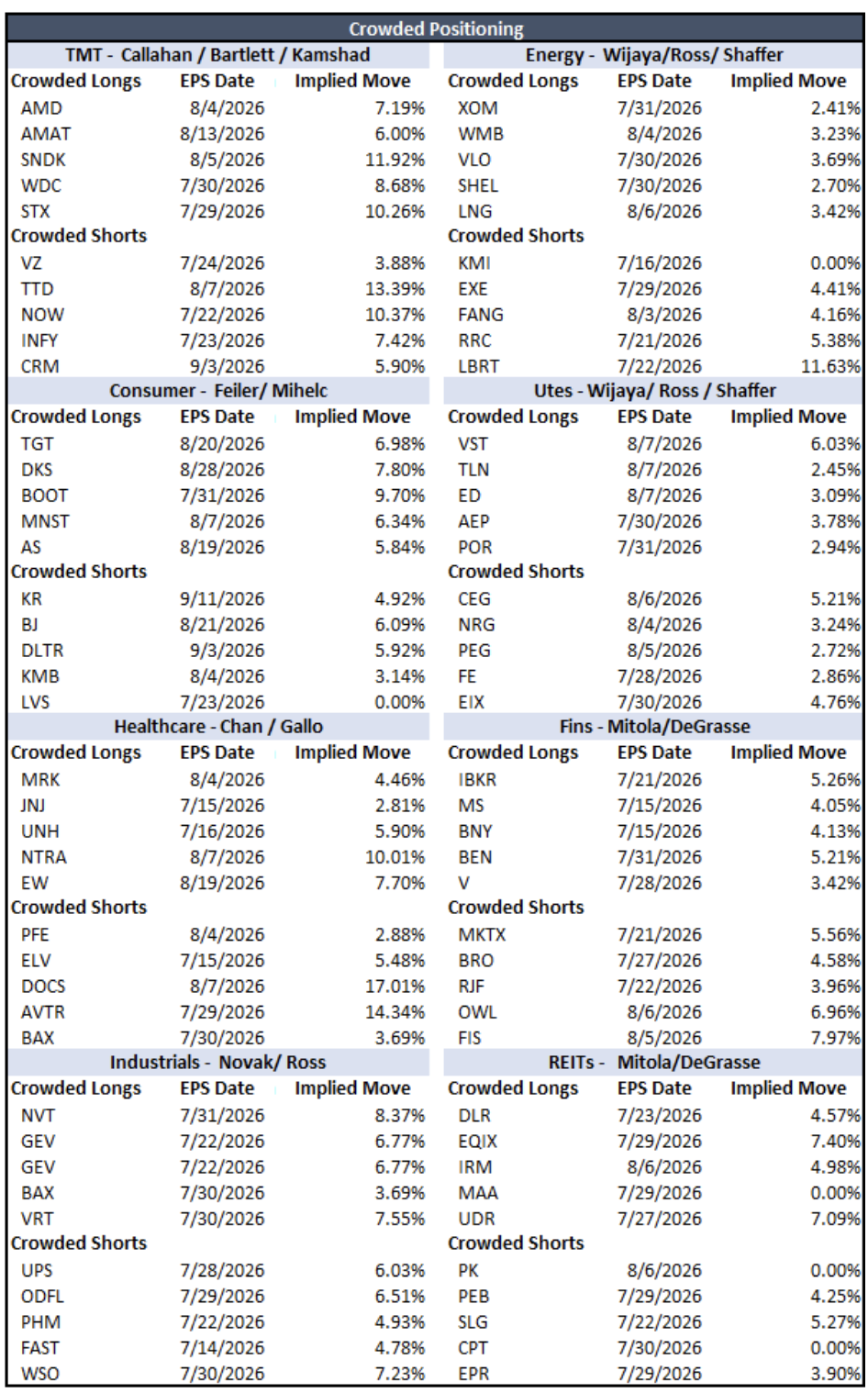
Q2 2026 earnings season begins this week with a heavy early catalyst slate: banks, UNH, ASML, TSM, and NFLX are the key highlights. By early August, roughly 75% of S&P 500 market cap will have reported, with NVDA on August 26 as the major late-cycle AI event.
The big-picture setup is constructive but demanding. Over the past 12 months, S&P 500 returns have been driven almost entirely by earnings growth, not multiple expansion. The index is up roughly 18%, while the forward multiple has not expanded and now sits around 20x. That means earnings delivery is doing the heavy lifting. The market is not being propelled by a fresh valuation re-rating; it is being sustained by profit growth.
The hurdle is high. Consensus expects 22% year-over-year EPS growth for Q2, the strongest since 2021. However, the market has cleared elevated expectations for 11 straight quarters, including Q1, when EPS growth came in at 27%, about 15 percentage points above expectations. So while the bar is high, investors have been conditioned to expect companies to beat it.
Key Themes This Quarter
The three major earnings themes are:
AI spending: capex, monetization, and ROI
AI infrastructure’s outsized contribution to S&P EPS growth
Input costs, pricing power, and margins
The earnings season is less about whether AI is still a major growth driver — it clearly is — and more about whether the market becomes more discerning about who earns the AI economics, who funds the capex, and whether enterprise AI demand is translating into measurable ROI.
AI — Still the Dominant EPS Engine
AI infrastructure remains the central driver of index-level earnings growth. The category is expected to represent roughly 60% of S&P 500 EPS growth this quarter. The top 10 EPS contributors are expected to generate around 75% aggregate growth, and MU plus NVDA alone account for more than 40% of overall EPS growth.
That concentration cuts both ways. On one hand, it shows the AI earnings engine remains powerful and should continue supporting index-level profits. On the other hand, it creates a very high bar for AI-exposed names. When such a large share of index EPS growth comes from a narrow set of companies, earnings season becomes a test of whether the market can broaden or whether it remains dependent on a small group of AI infrastructure winners.
The focus is also shifting. Earlier in the cycle, investors were most focused on hyperscaler capex budgets and AI infrastructure buildout. Now the market is increasingly focused on AI spending outside the hyperscalers and on enterprise ROI. That is important because enterprise inference spend appears to be funded mostly by new incremental budgets rather than simple reallocation. If companies can demonstrate that AI adoption is expanding budgets and driving productivity, the market will be more comfortable underwriting continued AI capex.
AI Capex — Less Estimate Volatility Than Q1, but 2027 Is the Question
AI capex remains the key debate. In Q1, hyperscaler capex estimates rose by more than $100bn, creating major estimate volatility and driving a powerful move in AI infrastructure. This quarter should see less capex-estimate volatility because 2026 budgets are largely set.
The more important question is 2027 planning. Those budgets are still early-stage, and more revisions are likely later in the year. This makes management commentary especially important. Investors will listen for whether hyperscalers are still accelerating, whether they are becoming more selective, and whether capital discipline is entering the conversation.
MSFT is particularly important because its fiscal year-end falls this quarter. That creates an important window for updated commentary around AI infrastructure, cloud demand, capex intensity, and 2027 planning assumptions. If MSFT signals continued capex confidence, it supports the data-center equipment and AI infrastructure complex. If it emphasizes discipline or spending digestion, the market may reprice parts of the AI supply chain.
The key framework remains: the market will eventually reward capital discipline and punish excessive AI capex, but that shift likely requires one of the large spenders to meaningfully change behavior. Until that happens, the AI infrastructure demand story remains intact.
Costs, Margins, and Sales Growth
The primary macro shift for Q2 is energy. Higher oil is a tailwind for Energy earnings but a headwind for Consumer EPS. That is especially relevant given the recent spike in crude tied to Middle East / Strait of Hormuz risk. If energy stays elevated, investors will increasingly focus on margin pressure, consumer elasticity, freight costs, and corporate pricing power.
The GS price tracker for prices paid and received is at its highest level since late 2023, which keeps margins front and center. Companies will need to show they can either pass through input costs or protect margins through productivity, mix, or cost control.
For now, median margins are expected to be roughly stable year-over-year. That is not spectacular, but it is good enough if sales growth holds up. The market’s tolerance for margin stability is higher when topline growth remains solid.
Sales expectations may be conservative. Median sales growth is expected at 5% year-over-year, down from 7% in Q1, but nominal GDP running around 7% creates upside risk to revenue estimates. If companies can deliver revenue beats while holding margins stable, earnings revisions should remain positive.
Median Stock vs. Index — Lower Bar Beneath the Surface
One important dynamic is that the median stock has a lower bar than the index. Median S&P 500 EPS is expected to grow 9%, down from 13% in Q1, but in line with the median growth rate seen in 2024–2025.
That matters because the aggregate index number is being pulled higher by AI infrastructure and a narrow group of large contributors. The median stock faces a more achievable earnings bar. This supports the broadening narrative if enough companies outside AI can deliver steady growth, stable margins, and constructive guidance.
In other words, the index has a high bar because AI winners are expected to do a lot. But the median stock has a more reasonable bar, which creates room for sector rotation if earnings breadth improves.
Fed Overhang — Earnings Drive Direction, but Policy Can Still Reprice the Tape
Earnings remain the main driver of equity direction, but near-term risk sits with the Fed. Markets now imply roughly 50bps of hikes through mid-2027. That is a meaningful overhang because higher yields pressure multiples, tighten financial conditions, and raise the bar for long-duration growth equities.
A dovish shift would be a powerful bullish catalyst. If CPI continues to soften and the Fed backs away from the need for additional tightening, equities could benefit from both earnings growth and a more supportive discount-rate backdrop. Conversely, if inflation reaccelerates due to energy or services, the market may have to absorb strong earnings alongside higher terminal-rate expectations.
That distinction is crucial. Strong earnings can support equities, but if the Fed reprices hawkishly, the multiple may struggle to expand. Given the index already trades around 20x, the market needs either continued earnings beats, lower yields, or both.
Banks — Constructive, but Deposit Competition Matters
The bank setup is broadly constructive. Big banks benefit from higher rates, strong loan growth, robust capital markets, and operating leverage. Early results from JPM, BAC, C, and WFC support that view: capital markets were strong, ECM and equities trading were exceptional, investment banking activity improved, and credit quality remained solid.
The key positive for large banks is that fee strength and market activity can offset some funding-cost pressure. JPM raising full-year NII guidance was particularly constructive, while positive read-throughs to MS and other fee-driven franchises make sense given the strength in equities trading and ECM.
Regionals are more complicated. Deposit competition may temper margins, and investors will be more focused on funding costs, deposit betas, and credit quality. Higher rates help asset yields, but they also increase competition for deposits. The large banks have more diversified revenue streams; regionals are more exposed to the NII and funding-cost tradeoff.
Credit cards look bullish if consumer spending holds and AI job fears fade. The key watchpoints will be delinquency trends, loss normalization, credit line growth, and commentary on consumer resilience. If card issuers confirm that spending remains healthy and credit is contained, it supports the broader soft-landing thesis.
Trading Implications
The earnings playbook argues for a selective but constructive stance:
Stay constructive on equities while earnings revisions remain positive.
Buy cleaned-up AI infrastructure and data-center exposure selectively, especially where valuations and positioning have reset.
Watch hyperscaler capex commentary carefully, particularly MSFT, for signs of 2027 spending discipline or continued acceleration.
Favor large banks over regionals where capital markets and fee strength can drive operating leverage.
Be cautious on consumer margins if energy remains elevated.
Look for broadening opportunities in median-stock earnings beats, given the lower bar outside the largest AI contributors.
Own index protection while vol remains cheap, because the market is near highs and the earnings bar is high.
Avoid overpaying for single-stock upside convexity, especially where call skew is already rich into earnings.
Disclaimer: The material provided is for information purposes only and should not be considered as investment advice. The views, information, or opinions expressed in the text belong solely to the author, and not to the author’s employer, organization, committee or other group or individual or company.
Past performance is not indicative of future results.
High Risk Warning: CFDs are complex instruments and come with a high risk of losing money rapidly due to leverage. 68% and 74% of retail investor accounts lose money when trading CFDs with Tickmill UK Ltd and Tickmill Europe Ltd respectively. You should consider whether you understand how CFDs work and whether you can afford to take the high risk of losing your money.
Futures and Options: Trading futures and options on margin carries a high degree of risk and may result in losses exceeding your initial investment. These products are not suitable for all investors. Ensure you fully understand the risks and take appropriate care to manage your risk.
Patrick has been involved in the financial markets for well over a decade as a self-educated professional trader and money manager. Flitting between the roles of market commentator, analyst and mentor, Patrick has improved the technical skills and psychological stance of literally hundreds of traders – coaching them to become savvy market operators!