SP500 LDN TRADING UPDATE 6/3/26

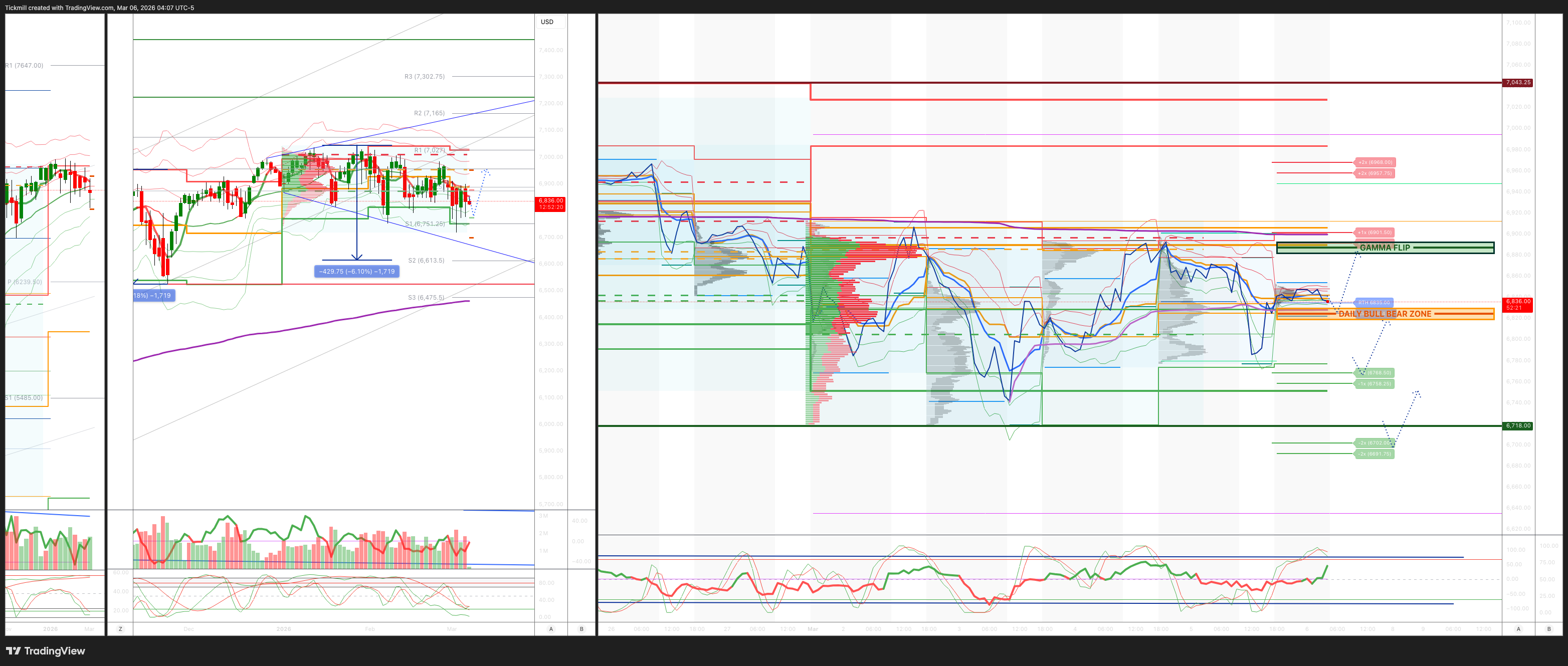
SP500 LDN TRADING UPDATE 6/3/26
WEEKLY & DAILY LEVELS
***QUOTING ES1! FOR CASH US500 EQUIVALENT LEVELS, SUBTRACT POINT DIFFERENCE***
WEEKLY BULL BEAR ZONE 6940/50
WEEKLY RANGE RES 7031 SUP 6745
Weekly Straddle Range: 143 -point straddle implies a weekly range of [6745, 7031]; monitor 1.5x and 2x moves for key reactions.
March OPEX Straddle: 232.8-point range suggests OPEX-to-OPEX movement between [6677, 7142].
March QOPEX Straddle: 368.55-point range projects [6466, 7203], based on December OPEX.
March EOM Straddle: 255.4-point straddle indicates a monthly range of [6623, 7101]. .
DEC2025 to DEC2026 OPEX straddle spans 945 points, outlining a range of [5889, 7779]."
DAILY VWAP BEARISH 6853
WEEKLY VWAP BEARISH 6917
MONTHLY VWAP BEARISH 6893
DAILY STRUCTURE – BALANCE - 6911/6718
WEEKLY STRUCTURE – OTFD
MONTHLY STRUCTURE - OTFD
Balance: This refers to a market condition where prices move within a defined range, reflecting uncertainty as participants await further market-generated information. Our approach to balance includes favouring fade trades at the range extremes (highs/lows) while preparing for potential breakout scenarios if the balance shifts.
One-Time Framing Higher (OTFH): This represents a market trend where each successive bar forms a higher low, signalling a strong and consistent upward movement.
One-Time Framing Lower (OTFD): This describes a market trend where each successive bar forms a lower high, indicating a pronounced and steady downward movement.
DAILY BULL BEAR ZONE 6829/19
GAMMA FLIP 6887
DAILY RANGE RES 6891/01 SUP 6868/58
2 SIGMA RES 6957/68 SUP 6702/91
VIX BULL BEAR ZONE 20
PUT/CALL RATIO 1.15 (The numbers reflect options traded during the current session. A put-call ratio below 0.7 is generally considered bullish, and a put-call ratio above 1.0 is generally considered bearish)
TRADES & TARGETS
LONG ON REJECT/RECLAIM OF DAILY BULL BEAR ZONE TARGET DAILY RANGE RES
LONG ON REJECT/RECLAIM OF DAILY RANGE SUP TARGET DAILY BULL BEAR ZONE
(I FADE TESTS OF 2 SIGMA LEVELS ESPECIALLY INTO THE FINAL HOUR OF THE NY CASH SESSION AS 90% OF THE TIME WHEN TESTED THE MARKET WILL CLOSE ABOVE OR BELOW THESE LEVELS)
GOLDMAN SACHS TRADING DESK VIEW - ‘Unwindy’
S&P closed down 56bps at 6,831 with a Market On Close (MOC) buy of $5bn. The Nasdaq 100 (NDX) dropped 29bps to 25,020, the Russell 2000 (R2K) plummeted 191bps to 2,586, and the Dow fell 161bps to 47,955. Total volume across US equity exchanges reached 22.2 billion shares, above the year-to-date daily average of 19.45 billion shares. The VIX surged +12.06% to 23.7, WTI Crude spiked +6.21% to $79.33, the US 10-Year Treasury yield rose 3bps to 4.13%, gold declined 124bps to 5,075, the DXY Index gained 28bps to 99.05, and Bitcoin dropped 2.79% to $71,298.
US equities broadly declined as volatility (VIX), yields, and oil prices climbed higher, driven by ongoing geopolitical tensions in the Middle East despite some stability in Asian markets. Defensive sectors, which had seen rotation in recent weeks (P&C insurance, real estate, staples, healthcare), were notably weak, while previously out-of-favor areas like alternatives, fintech, payments, and software showed strength.
Software led gains, finishing +3% on the day and marking a 15% recovery from recent lows, with four consecutive days of positive performance. Key drivers included oversold conditions (record low positioning per GS PB), resilience in the face of negative news (e.g., WDAY up 25% from post-earnings lows), improved earnings reactions (e.g., VEEV, OKTA), partnerships like Anthropic collaborating with incumbents rather than displacing them, and OpenAI scaling back its direct GPT shopping ambitions. The rally appeared to be fueled by a cessation of high-velocity supply and short covering.
Looking ahead, the Non-Farm Payrolls (NFP) report is due tomorrow, with expectations of a +45k headline increase (consensus +55k), average hourly earnings (AHE) rising +30bps MoM, and the unemployment rate ticking up to 4.4%. Markets may not react strongly unless the data is significantly negative, with implied volatility suggesting a 0.99% move through tomorrow’s close.
Trading activity remained subdued, with overall activity levels rated a 4 on a 1-10 scale. The floor ended -319bps for sale versus a 30-day average of +30bps. Single-stock trading was muted as investors lacked conviction in either direction. Asset managers were net sellers of $1bn, with selling concentrated in macro and tech sectors. Hedge funds were net sellers of $700m, with supply focused in macro and communication services, while demand was seen in healthcare. Liquidity remained thin, with ETFs accounting for 40% of trading volume and light top-of-book liquidity at $4.8mm.
Post-market, GAP dropped 9% on mixed earnings results, following weak trading in specialty retail stocks like AEO and VSCO earlier in the day, signaling potential challenges ahead.
In derivatives, the market saw continued choppy trading within the tightest intraday SPX range recorded this year. One straddle was realized to the downside, with flows favoring hedgers—primarily buyers of put spreads, which remain attractive given current skew levels. Ratio put spreads in SPX are still seen as the most appealing short-dated trade. A strong bid for volatility emerged as the market sold off, with elevated intraday volatility of volatility. However, volatility eased significantly as markets rallied into the close.
Disclaimer: The material provided is for information purposes only and should not be considered as investment advice. The views, information, or opinions expressed in the text belong solely to the author, and not to the author’s employer, organization, committee or other group or individual or company.
Past performance is not indicative of future results.
High Risk Warning: CFDs are complex instruments and come with a high risk of losing money rapidly due to leverage. 68% and 74% of retail investor accounts lose money when trading CFDs with Tickmill UK Ltd and Tickmill Europe Ltd respectively. You should consider whether you understand how CFDs work and whether you can afford to take the high risk of losing your money.
Futures and Options: Trading futures and options on margin carries a high degree of risk and may result in losses exceeding your initial investment. These products are not suitable for all investors. Ensure you fully understand the risks and take appropriate care to manage your risk.
Patrick has been involved in the financial markets for well over a decade as a self-educated professional trader and money manager. Flitting between the roles of market commentator, analyst and mentor, Patrick has improved the technical skills and psychological stance of literally hundreds of traders – coaching them to become savvy market operators!